A local mom told me about her approach to Spanish with her children. Every few weeks she chooses a game (Chutes and Ladders, checkers, Hungry Caterpillar Game, or such) and teaches her children the vocabulary which go with the game. She taught them to count for Chutes and Ladders (Mancala would be good for this, too - Chutes and Ladders makes me nuts!) or taught food words for Hungry Caterpillar foods. Then, they play the game for a few weeks.
We have a game library here, but someone without one could trade games with friends and neighbors. This localizes the use of the language well to help prevent language mixing ("We've opened up a game, now we speak Japanese!") while linking the language to positive attention from the parents. This might also encourage the children to use the language because they are less likely to be forced into situations their vocabulary can't handle. We'll definitely do this tomorrow! Stayed tuned for how it goes!
*UPDATE*
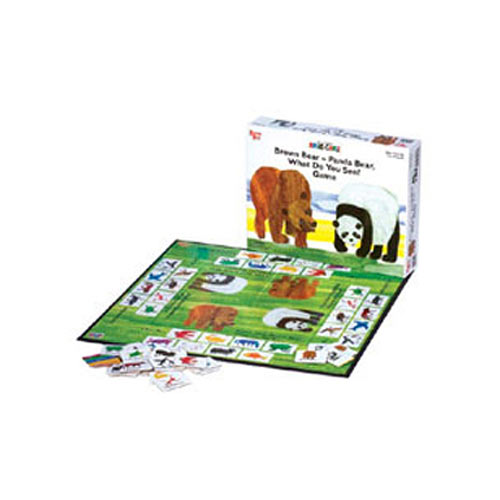
A and I had a good time playing the Brown Bear game. She volunteered all the colors but had to be coaxed through the animals (which was a surprise to me) and the fairly simple sentence structure. I think if we do it a few times she'll be pretty comfortable with it. I guess that post will come next week.
My grandmother always told me never to let school get in the way of an education and I don't plan to start now! This blog is to help our families know what our homeschool looks like, but others are welcome to look as well.
Showing posts with label games. Show all posts
Monday, December 20, 2010
German game ideas
Friday, December 10, 2010
Contig Jr.
Thanks to Let's Play Math we played our first round of Contig Jr. today and it was a complete success. Each turn led to multiple computations as my son tried every combination of addition and subtraction he could come up with to maximize his points. We'll definitely add this to our repertoire.
Thursday, December 9, 2010
War and Peace
We play lots of War (and Peace) in our house. It's the the card game that's worth 1000 worksheets.
We're currently using it for addition and pre-subtraction. Today, we played War. J added up his cards (we played with three at a time per person), then added up my cards, told me which hand was more, and by how much (stealth subtraction). I gave him the abacus to use when necessary. I do worry that he's not noticing patterns because of his dependence on the abacus, but I'll probably wait a while before requiring him to do it mentally. Now, I simply point out ways he could have done the calculation more quickly.
"Notice you had 9, 7, and 3. You could have added 7 and 3 first, and then 9. Then you wouldn't have needed the abacus."
Time will show whether systematic teaching will be necessary a few months down the road or if games will suffice!
Subscribe to:
Posts (Atom)