I used to love message boards, but I promised my hubby I'd go message board free for six months if we bought a certain curriculum. I made the promise for a few reasons. First, the point of a curriculum, for me, is to save time, so if I spend hours figuring out ways to tweak it, I shouldn't be paying lots of money for it. Second, I knew that I'd quickly become dissatisfied with any curriculum if I saw all the opinions people gave about it on a message board.
So, as with some time removed from message boards, I can see how discontent I become when I read them. The board is gossip central, with everyone talking about their new and exciting curriculum. Everyone has a brilliant child (or, at least, the outspoken people are ones with brilliant children, or, minimally, children who happened to have a brilliant five minutes that morning) and is eager to share how this that or the other curriculum was too simple/boring/slow for their child. Well, I want my children to show signs of brilliance and then start looking for that same curriculum to fail for my child, or I may just pine for that new, more perfect curriculum that will effortlessly teach my child how to spell/write/speak Spanish/train elephants/etc.
Our math curriculum is a victim of the message boards. I loved Right Start A. It was perfect. Everyday was exhilarating. Even though we haven't consistently RSed since October, I can see my son's ability to understand the math I teach him stemming directly from the great RS foundation he has.
However, comments on the boards talked about how "slow" RS is (another word for slow could be "thorough" or "careful") and about how their children were "bored" (it is somewhat scripted, but one doesn't have to spend a lot of time on each section). Then, I, wanting to turn against it, started agreeing.
We're going back to RS tomorrow. It deserves a chance. It is exceptionally thorough and teaches concepts from multiple viewpoints. It will help prevent "holes" - which really can exist! My son is dangerous because he can figure things out, which I could do, too. The danger is that you figure out the motions to go through without actually understanding. I don't think RS will allow that!
Here's my commitment:
- four weeks
- four days per week
- 20-25 minutes per day
- do all sections
- continue to next section without extra review if seems appropriate
I'll update with my new opinion of RS in mid-February.
Thursday, January 13, 2011

Thursday, January 6, 2011
What is the point of games?
We live on the California coast. We are surrounded by hippies and unschoolers who use games to (essentially) trick their children into learning. Some abhor curricula and believe that games and life experience will provide their children's foundational skills.
I'm not an unschooler. I'm constantly shocked by the things my children learn on their own, but direct instruction is at the heart of our homeschool (and life). From things like, "We say please if we want someone to do something for us," to "You must apologize to your sister if you cause her harm," to "G may say /j/ when followed by E, I, or Y," we utilize direct instruction all the time.
 So I find myself asking myself why I play games with my children. Of course we love math games for reinforcing skills, but games are more fundamental to our school than that. We play math games that cover skills we've never learned and we play physics games that demonstrate ideas that I remember from college. Why?
It's fun, of course, but there's more than that. By playing games, my children are gently introduced to concepts before they are taught them. When I teach the concepts, they come much more naturally because they have become intuitive. They will think these subjects are easy and consider themselves good at them, and will be more likely to like them.
Of course, any subject worth studying eventually becomes hard. But hopefully curiosity and adventure will take over by then.
I'm not an unschooler. I'm constantly shocked by the things my children learn on their own, but direct instruction is at the heart of our homeschool (and life). From things like, "We say please if we want someone to do something for us," to "You must apologize to your sister if you cause her harm," to "G may say /j/ when followed by E, I, or Y," we utilize direct instruction all the time.

It's fun, of course, but there's more than that. By playing games, my children are gently introduced to concepts before they are taught them. When I teach the concepts, they come much more naturally because they have become intuitive. They will think these subjects are easy and consider themselves good at them, and will be more likely to like them.
Of course, any subject worth studying eventually becomes hard. But hopefully curiosity and adventure will take over by then.
Friday, December 31, 2010
Making language decisions towards Spanish
Everyday seems to present more reasons we should do Spanish as a homeschool family. I don't think a single receptionist at our doctor's office doesn't speak Spanish. Most of the doctors speak Spanish, too.
We can buy books in Spanish cheaply and get many at our library. We can listen to the radio in Spanish. We could theoretically watch TV and movies in Spanish. We can volunteer in Spanish.
It isn't a language with a high chic factor. No one says, "Wow, you learned Spanish? You must be a genius!" However, it is a language that makes sense.
We can buy books in Spanish cheaply and get many at our library. We can listen to the radio in Spanish. We could theoretically watch TV and movies in Spanish. We can volunteer in Spanish.
It isn't a language with a high chic factor. No one says, "Wow, you learned Spanish? You must be a genius!" However, it is a language that makes sense.
We're back!
We're back from our trip to the snow!
We made maple-sugar-snow candy, like Laura and Mary in the Little House in the Big Woods. J made a snow man. A enjoyed cutting, cutting, and more cutting with her Kumon Workbooks. She's becoming very proficient! M enjoyed lots of Grandma laps and drawing.
Hubby and I went cross-country skiing three days in a row. I almost wish I had grown up in Minnesota so that I could have been on an XC ski team in high school. It is a lot more fun than XC running.
We're moving towards getting back into the swing of things. I made J a simple math worksheet today and of course he's reading aloud. One of his Christmas presents was his own simplified Bible that he gets to stay up later than the girls to read each night. Although that isn't "school work" it helps towards developing fluent reading skills.
We'll be moving back into RightStart B and Spell to Write and Read on Monday.
Yay for a relaxing trip!
We made maple-sugar-snow candy, like Laura and Mary in the Little House in the Big Woods. J made a snow man. A enjoyed cutting, cutting, and more cutting with her Kumon Workbooks. She's becoming very proficient! M enjoyed lots of Grandma laps and drawing.
Hubby and I went cross-country skiing three days in a row. I almost wish I had grown up in Minnesota so that I could have been on an XC ski team in high school. It is a lot more fun than XC running.
We're moving towards getting back into the swing of things. I made J a simple math worksheet today and of course he's reading aloud. One of his Christmas presents was his own simplified Bible that he gets to stay up later than the girls to read each night. Although that isn't "school work" it helps towards developing fluent reading skills.
We'll be moving back into RightStart B and Spell to Write and Read on Monday.
Yay for a relaxing trip!
Wednesday, December 22, 2010
Monday, December 20, 2010
German game ideas
A local mom told me about her approach to Spanish with her children. Every few weeks she chooses a game (Chutes and Ladders, checkers, Hungry Caterpillar Game, or such) and teaches her children the vocabulary which go with the game. She taught them to count for Chutes and Ladders (Mancala would be good for this, too - Chutes and Ladders makes me nuts!) or taught food words for Hungry Caterpillar foods. Then, they play the game for a few weeks.
We have a game library here, but someone without one could trade games with friends and neighbors. This localizes the use of the language well to help prevent language mixing ("We've opened up a game, now we speak Japanese!") while linking the language to positive attention from the parents. This might also encourage the children to use the language because they are less likely to be forced into situations their vocabulary can't handle. We'll definitely do this tomorrow! Stayed tuned for how it goes!
*UPDATE*
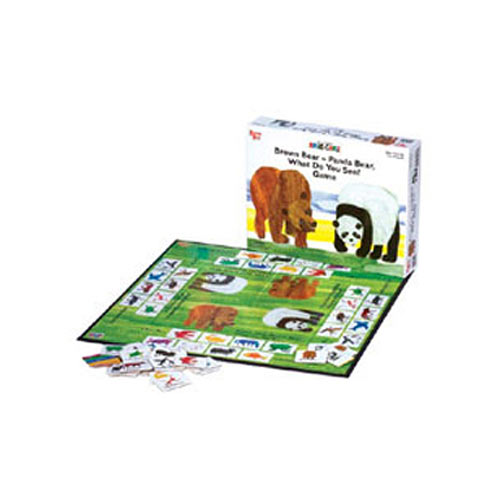
 A and I had a good time playing the Brown Bear game. She volunteered all the colors but had to be coaxed through the animals (which was a surprise to me) and the fairly simple sentence structure. I think if we do it a few times she'll be pretty comfortable with it. I guess that post will come next week.
We have a game library here, but someone without one could trade games with friends and neighbors. This localizes the use of the language well to help prevent language mixing ("We've opened up a game, now we speak Japanese!") while linking the language to positive attention from the parents. This might also encourage the children to use the language because they are less likely to be forced into situations their vocabulary can't handle. We'll definitely do this tomorrow! Stayed tuned for how it goes!
*UPDATE*
Thursday, December 16, 2010
Multilingualism and bird calls
While in Boston, we were members of LEX/Hippo Family Club, which encourages multilingualism and taught us that it is actually easier to learn languages when one is learning more than one at a time. According to the research they sited, a different part of your brain turns on and your ears are better able to listen to foreign sounds when being bombarded by a large variety of them. Maybe hearing a bunch of crazy sounds at once tells you that you can't map each of them to a sound set you already know. I don't quite know. I experienced a similar thing with bird songs. After spending half an hour in the car listening to a bird sounds CD, I thought somehow I was still listening to it when I got out of the car. My ear was attuned to bird sounds and suddenly the neighborhood was full of them. When you listen a lot to multiple languages, the sounds you couldn't rightly hear at the beginning become clearer.
Learning more than one language at a time seems to be discouraged nowadays, often in chat rooms or in general conversation, but it has many precedents. Charlotte Mason's teachers taught children French and German from before age six, of course beginning with rhymes and songs, and Rudolf Steiner did the same, although I'm not sure what the two languages were! In the USA, Waldorf schools usually teach German and Spanish simultaneously. They also teach through song and rhymes.
Not to be outdone, but mainly because I think it makes a lot of sense scientifically, we'll be adding Spanish through songs and rhymes to our homeschool curriculum in spring of the coming year. I'm working on the curriculum now, but mom needs to do some work on her own (barely there) Spanish, first. I love languages! This is fun!
Learning more than one language at a time seems to be discouraged nowadays, often in chat rooms or in general conversation, but it has many precedents. Charlotte Mason's teachers taught children French and German from before age six, of course beginning with rhymes and songs, and Rudolf Steiner did the same, although I'm not sure what the two languages were! In the USA, Waldorf schools usually teach German and Spanish simultaneously. They also teach through song and rhymes.
Not to be outdone, but mainly because I think it makes a lot of sense scientifically, we'll be adding Spanish through songs and rhymes to our homeschool curriculum in spring of the coming year. I'm working on the curriculum now, but mom needs to do some work on her own (barely there) Spanish, first. I love languages! This is fun!
Subscribe to:
Posts (Atom)